
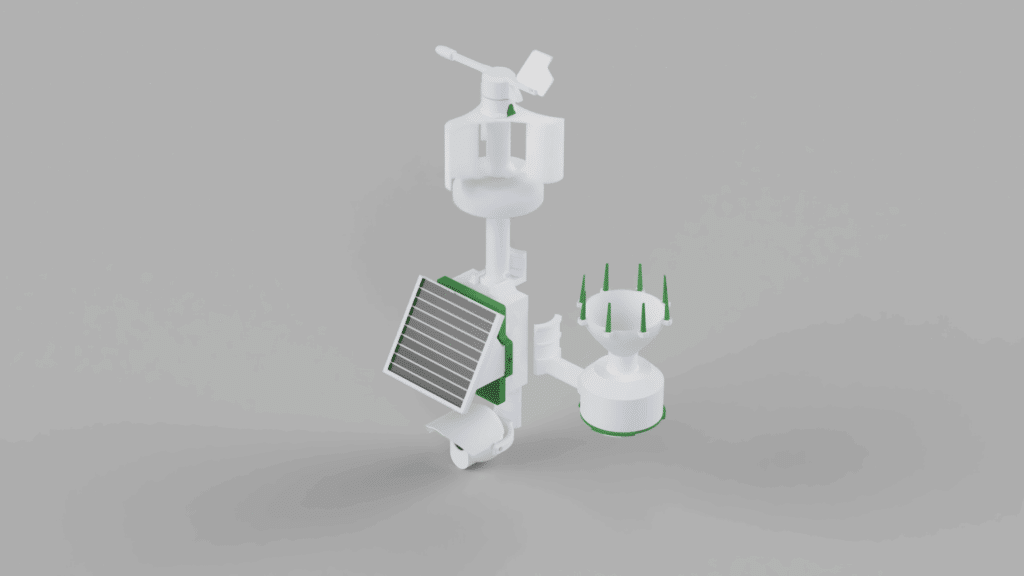
How 3D Printing Propelled iWeather forward
The iWeathar weather station is a long-term project I’ve worked on over several years, both as a full-time employee and later as a freelancer. A big part of this project was taking the existing designs and adapting them to print without support, requiring a deep knowledge of 3D Printed Design.
The original design existed in SketchUp, but I migrated everything over to Fusion 360 and began a long process of iterative improvement. The result is a fully 3D-printable weather station, with every single part designed to print without supports — a key goal from the outset.
Optimized for ease of printing, durability, and modular assembly, this project involved a lot of problem-solving around overhangs, bridging, and print orientation. The station is printed entirely in PLA and has been used in real-world weather conditions for continuous monitoring.
The Advantages of 3D Printed Design
Because the station was fully 3D printed and optimised for printing, this allowed rapid prototyping and a near instant swing to new production parts. If a more efficient way was found to design a part, it was designed to fit the old existing system, printed, tested and could go into production the very next day!
In a typical production process, such as injection molding, this would be unthinkable as it would take time for new molds to be manufactured and tested. But thanks to the power of 3D printing, we iterated and developed new parts essentially over night.
Software Used: Fusion 360 (design), Cura (slicing)
Manufacturing: 3D printed in PLA
Deliverables: STL files, Fusion models, print-ready iterations
Highlights:
- Fully printable with zero supports
- Modular and field-tested design
- Ongoing upgrades and improvements based on real-world use
If you’re in need of manufacture ready parts for your project, please reach out and let us help you!